Living Treasures Animals
Check out our animal list below!

African Crested Porcupine
Hystix cristata
This rodent uses its quills as a defense mechanism; they will run backwards into their assailant and use their quills, which are most concentrated in the rear, to run off the potential danger.

American Alligator
Alligator mississippiensis
They move quickly through water, using their powerful tail to propel themselves, but are slow-moving on land.
​
​

Bar-Headed Goose
Anser indicus
They are the highest flying goose in the world, reaching elevations of more than 23,000 ft. They have been seen flying over Mount Everest.

Black Swan
Cygnus atratus
Black Swans have a wingspan up to six feet!
​
_edited.avif)
Burmese Python
Python bivittatus
They are good swimmers and can stay under water for up to 30 min.
​
​

Chilean Flamingo
Phoenicopterus chilensis
They stand out from other species of Flamingos with their grey legs and pink ankles. That's right, what you may think is a knee, is actually an ankle.

Common Marmoset
Callithrix jacchus
The father and siblings are very involved with caring for the newborns.
​

Dromedary Camel
Camelus dromedarius
They are capable of going two weeks without water and can drink up to 30 gallons in just 10 minutes.

Eruasian Eagle Owl
Bubo bubo
They are the largest species of owl in the world. They are an apex predator and have no predators above them.
​

Golden Pheasant
Chrysolophus pictus
Although they can fly, they are quite clumsy in flight and are more comfortable on the ground, preferring to run.
​

Honey Badger (Ratel)
Mellivora capensis
Holds record in the Guinness Book of World Records for being "the most fearless animal in the world". Their thick skin can withstand bee stings and porcupine quills and they are even resistant to cobra venom.

Lovebird
Agapornis
Lovebirds are social and affectionate. Their name stems from the parrot's strong monogamous pair bonding and the long periods in which the paired birds spend sitting together.
​

Scarlet Macaw
Ara macao
They are known for having the longest tailfeathers in the Macaw family.
​
​
​

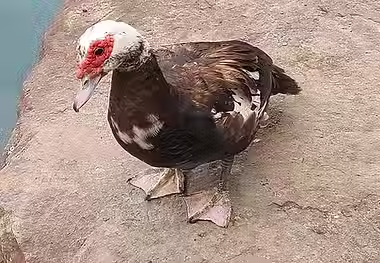
Muscovy Duck
Cairina moschata
They are tropical birds that adapt well to colder climates. The red knobs on their faces are called carnucles.
​
​

Nigerian Dwarf Goat
Capra hircus
They were originally bred for show and as a companion animal but are now bred for dairy use also.
​
​

Indian Peafowl
Pavo cristatus
Males are called "Peacocks" and females are called "peahens". The males raise their feathers in a fan and will quiver them in a display during courtship .
​

Pygmy Hippopotamus
Choeropsis liberiensis
They are very reclusive, spending most of the day hidden in rivers and resting in the same spot for several days before moving on.
​
​

Alligator Snapping Turtle
Macrochelys temminckii
Part of the Camelidae family (which includes camels and llamas), these woolly mammals are a social species who are never seen with less than 3 members to a herd.
​

Asian Small-Clawed Otter
Aonyx cinerea
Each individual Otter has its own unique scent like Human fingerprints, the scent allows otters to recognize each other.
​
​

Barnacle Goose
Branta Leucopsis
They are part of the "Branta" family. "Branta" is Latin for "Burnt Goose" referring to geese with mostly black plumage.

Blue Crowned Pigeon
Goura cristata
They exhibit a large variety of vocalizations including a rumbling call and a loud "boom".

Common Call Duck
Anas platyrhyncos
Originally known as "coy" ducks, they were often used as decoys, as their loud calls can be heard over long distances and they attract other ducks into the area.

Clouded Leopard
Neofelis nebulosa
They are not able to roar like a big cat or meow like a small cat. They growl, hiss and chuff.
​

Conure
Enicognathus
They are a small to medium sized parrot. Their calls are very loud and can be carried over many miles.

Egyptian Fruit Bat
Rousettus aegyptiacus
They can have a wing span of up to 2 feet with an average body length of just 6 inches.
​
.avif)
Fallow Deer
Dama dama
Fallow Deer come in a variety of colors from near white to tan and dark brown. The can have a solid coat or have spots. Their color and pattern stay with them throughout their lifetime.
.avif)
Guanaco
Lama guanicoe
While other Camlids like Alpaca and Llama come in a variety of colors and patterns, the Guanaco only comes in light to dark brown, a light underbelly and a grey face.

Jacob Sheep
Ovis aries
Ancient breed from the Middle East. They were imported to North America in the early 1900's and very little has changed with the breed since.
​
​

Blue and Gold Macaw
Ara ararauna
They are known for being the most talkative of the Macaw family.
​
​
​

Magpie Goose
Anseranas semipalmata
Unlike most ducks and geese with fully webbed feet, the Magpie Geese have only partially webbed feet.
​
​

Mute Swan
Cygnus olor
They are monogamous and strongly territorial. The male swan is a cob, the female is a pen and the baby is a cygnet.
​
​

Parakeet
Melopsittacus undulatus
The part above their beak is called the cere, pronounced "seer". It is blue on males and brown, tan or pink on females.
​

Pony
Equus caballus
There are more than 200 breeds on ponies. The Shetland Pony is the most well known.
​
​
​
.avif)
Redhead Duck
Aythya americana
They are specially adapted for diving and foraging underwater. The webbing on their feet is larger than dabbling ducks and their bills are broader.
​
​

Alpaca
Vicugna pacos
Part of the Camelidae family (which includes camels and llamas), these woolly mammals are a social species who are never seen with less than 3 members to a herd.
​

Ball Python
Python regius
These snakes derive their name from their defensive act of rolling into a ball when threatened. Originally called the Royal Python, they were also historically worn as jewelry by Royalty back in the day.

Bennet's Wallaby
Macropus rufogriseus
Females of this species can be referred to as either does or flyers while the males are called bucks or boomers.

Brazilian Tapir
Tapirus terrestris
Even though they look like pigs with trunks, they are actually related to horses and rhinoceroses.

Capybura
Hydrochoerus hydrochaeris
They are semi-aquatic. Well adapted for land or water, they have webbed toes and fast drying fur, but can also run up to 22 miles per hour.
​

Cockatiel
Nymphicus hollandicus
They are very social birds. The males have great vocal abilities while the females are fairly quiet.
​

Dingo
Canis lupus dingo
Although they max out at around 60 pounds, they are the largest carnivore in Australia.
​

Emu
Dromaius novaehollandiae
Emu are the second largest bird in the world.
​
​

Flemish Rex Rabbit
Oryctolagus cuniculus
They are one of the largest breeds of rabbit. They are docile and tolerant of being handled.
​
​
%20(1).avif)
Gyr Cattle
Bos primigenius indicus
They are considered the most gentle of the Zebu breeds. They are resistant to heat and disease
​
​

Laughing Kookaburra
Dacelo novaeguineae
They are the largest member of the kingfisher family. Known for their laughter-like call.
​
​
​

Military Macaw
Ara militaris
They live in large flocks and are very noisy, often heard long before they are seen.
​
​
​

Reeve's Muntjac Deer
Muntiacus reevesi
They are known as "the barking deer". They are one of the most audible members of the deer family.
​
​

Nicobar Pigeon
Caloenas nicobarica
They are able to drink by placing their bill in water and drinking. They do not need to tip their heads back to swallow like other birds.
​
​

Peacock Pheasant
Polyplectron bicalcaratum
The "eye spots" on their feathers look like eyes and are used to scare away predators.
​
​
​

Prairie Dog
Cynomys
Their burrows have separate rooms for eating, sleeping, nursing and even using the bathroom.
​
​
​

Red Kangaroo
Macropus rufus
They are the largest of the Kangaroo Species. They get most of their hydration from vegetation and can go without water for long periods of time.